Matteo Frittelli began his professional journey specializing in cinematography and directing in the late 90s. His style is built upon a profound and contemplative narrative, characterized by a conceptual approach that leans towards lyrical suspension. Free from all rhetorical tension, his work focuses on subtle nuances, transforming every subject into a rich and penetrating exploration.
Matteo Frittelli was born in Florence in 1973. His educational path was characterized by an assiduous contact with the world of contemporary art. The friendships with numerous Italian and international artists and his first job experience in Rome, where he worked as a counselor for television production studies, inspired him to become a film director.
Matteo Frittelli began his professional journey specializing in cinematography and directing in the late 90s. His style is built upon a profound and contemplative narrative, characterized by a conceptual approach that leans towards lyrical suspension. Free from all rhetorical tension, his work focuses on subtle nuances, transforming every subject into a rich and penetrating exploration.
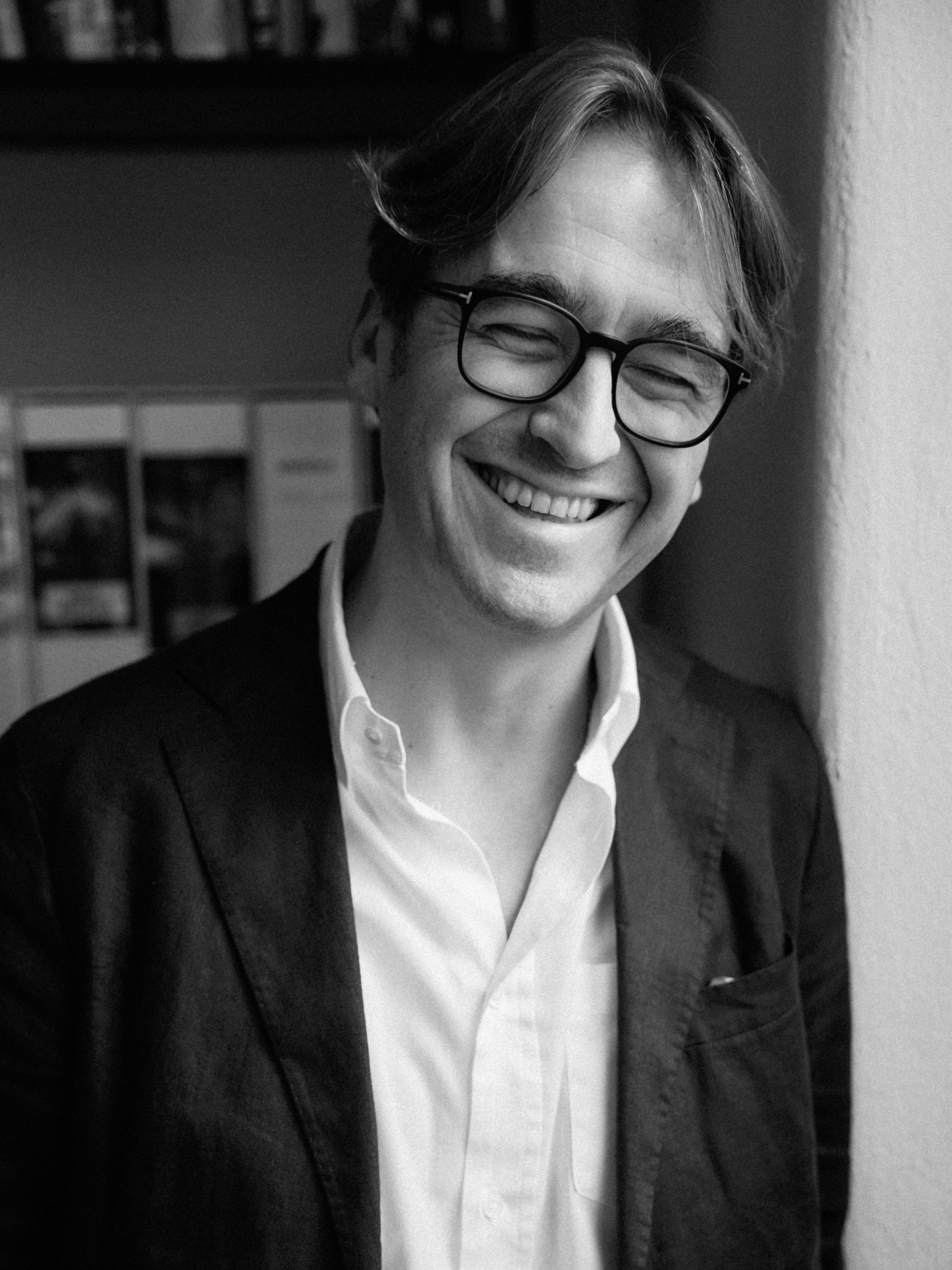
In 2007, he opened his own studio based in Florence. As an expert documentarist, in his projects he prioritize a calm yet unexpected point of view, avoiding any sort of rhetoric tension and focusing on underlining meanings in all projects.
To be honest I put myself in the category of people who are best able to give form to their ideas by arguing — I entirely subscribe to the view that truth is reached through dispute. Otherwise I tend to fall into a reflective state which suits the metaphysical bent of my character and is not conducive to an energetic, creative thought process, since it affords only emotional material with which to construct a — more or less well-ordered — framework for my ideas.
(From the introduction to:
Sculpting in Time, Andrej Tarkovskij)
Throughout his career, he has cultivated a profound interest in art documentation. Among his most significant works is the art film La Personne De Georges Adéagbo, presented in 2012 at the Triennale de Paris, at the Palais de Tokyo. Subsequently, in 2019, his documentary Carlo Alfano: Tra l’Io e l’Altro (Carlo Alfano: Between the Self and the Other) inaugurated the 24th edition of the Artecinema festival at the Teatro San Carlo in Naples. Recently, he directed a short film dedicated to the American artist James Turrell, presented in AlUla on the occasion of the artist’s solo exhibition in Saudi Arabia and the documentary film Marco Bagnoli. Radici nel cielo, presented at the 30th edition of Artecinema.
Throughout his career, Matteo has cultivated a profound interest in art documentation. Among his most significant works is the art film La Personne De Georges Adéagbo, presented in 2012 at the Triennale de Paris, at the Palais de Tokyo. Subsequently, in 2019, his documentary Carlo Alfano: Tra l’Io e l’Altro (Carlo Alfano: Between the Self and the Other) inaugurated the 24th edition of the Artecinema festival at the Teatro San Carlo in Naples. Recently, he directed a short film dedicated to the American artist James Turrell, presented in AlUla on the occasion of the artist’s solo exhibition in Saudi Arabia and the documentary film Marco Bagnoli. Radici nel cielo, presented at the 30th edition of Artecinema.
In 2007, he opened his own studio based in Florence. As an expert documentarist, in his projects he prioritize a calm yet unexpected point of view, avoiding any sort of rhetoric tension and focusing on underlining meanings in all projects.
To be honest I put myself in the category of people who are best able to give form to their ideas by arguing — I entirely subscribe to the view that truth is reached through dispute. Otherwise I tend to fall into a reflective state which suits the metaphysical bent of my character and is not conducive to an energetic, creative thought process, since it affords only emotional material with which to construct a — more or less well-ordered — framework for my ideas.
(From the introduction to: Sculpting in Time, Andrej Tarkovskij)
Throughout his career, he has cultivated a profound interest in art documentation. Among his most significant works is the art film La Personne De Georges Adéagbo, presented in 2012 at the Triennale de Paris, at the Palais de Tokyo. Subsequently, in 2019, his documentary Carlo Alfano: Tra l’Io e l’Altro (Carlo Alfano: Between the Self and the Other) inaugurated the 24th edition of the Artecinema festival at the Teatro San Carlo in Naples. Recently, he directed a short film dedicated to the American artist James Turrell, presented in AlUla on the occasion of the artist’s solo exhibition in Saudi Arabia and the documentary film Marco Bagnoli. Radici nel cielo, presented at the 30th edition of Artecinema.
In 2007, he opened his own studio based in Florence. As an expert documentarist, in his projects he prioritize a calm yet unexpected point of view, avoiding any sort of rhetoric tension and focusing on underlining meanings in all projects.
To be honest I put myself in the category of people who are best able to give form to their ideas by arguing — I entirely subscribe to the view that truth is reached through dispute. Otherwise I tend to fall into a reflective state which suits the metaphysical bent of my character and is not conducive to an energetic, creative thought process, since it affords only emotional material with which to construct a — more or less well-ordered — framework for my ideas.
(From the introduction to:
Sculpting in Time, Andrej Tarkovskij)
Throughout his career, he has cultivated a profound interest in art documentation. Among his most significant works is the art film La Personne De Georges Adéagbo, presented in 2012 at the Triennale de Paris, at the Palais de Tokyo. Subsequently, in 2019, his documentary Carlo Alfano: Tra l’Io e l’Altro (Carlo Alfano: Between the Self and the Other) inaugurated the 24th edition of the Artecinema festival at the Teatro San Carlo in Naples. Recently, he directed a short film dedicated to the American artist James Turrell, presented in AlUla on the occasion of the artist’s solo exhibition in Saudi Arabia and the documentary film Marco Bagnoli. Radici nel cielo, presented at the 30th edition of Artecinema.

Matteo Frittelli with Antony Gormley, 2017.
Since 2017, he has directed Alto Piano Studio in Milan, which he co-founded with his friend, the photographer Agostino Osio, spanning projects for the world of contemporary art, fashion, and culture.
Since 2017, he has directed Alto Piano Studio in Milan, which he co-founded with his friend, the photographer Agostino Osio, spanning projects for the world of contemporary art, fashion, and culture.
Since 2017, he has directed Alto Piano Studio in Milan, which he co-founded with his friend, the photographer Agostino Osio, spanning projects for the world of contemporary art, fashion, and culture.
Correspondence
& Contacts
Alto Piano Studio
Via Nerino, 8
20123 Milan, Italy
+39 0282762918
altopiano@altopiano.studio
www.altopiano.studio
Correspondence
& Contacts
Alto Piano
Via Nerino, 8
20123 Milan, Italy
(+39) 0282762918
altopiano@altopiano.studio
www.altopiano.studio

Matteo Frittelli with Massimo Bartolini, 2024.
There are therefore two moments in the manifestation of this art: first, its actual production — real, ephemeral, transitory — tied to a fleeting visibility; second, its documentation, which is in fact its second act of birth, its second production, making possible its lasting availability and permanent identification.
(Marcher, créer. Déplacements, flâneries, dérives
dans l’art de la fin du XXe siècle by Thierry Davila)
There are therefore two moments in the manifestation of this art: first, its actual production — real, ephemeral, transitory — tied to a fleeting visibility; second, its documentation, which is in fact its second act of birth, its second production, making possible its lasting availability and permanent identification.
(Marcher, créer. Déplacements, flâneries, dérives dans l’art de la fin du XXe siècle by Thierry Davila)
There are therefore two moments in the manifestation of this art: first, its actual production — real, ephemeral, transitory — tied to a fleeting visibility; second, its documentation, which is in fact its second act of birth, its second production, making possible its lasting availability and permanent identification.
(Marcher, créer. Déplacements, flâneries, dérives
dans l’art de la fin du XXe siècle by Thierry Davila)
Awards & Achievements
Awards & Achievements
2025
At the 18th edition of Lo Schermo dell’Arte, he presented the documentary film Massimo Bartolini. Due qui / To Hear, in Florence.
2025
At the 30th edition of Artecinema, the International Festival of Films on Contemporary Art, he presented the documentary film Marco Bagnoli. Radici nel cielo, at the Teatro Augusteo in Naples.
2025
Appointed by the Royal Commission of AlUla (RCU), he directed for Alto Piano a short film about the conceptual process behind James Turrell’s project in the Wadi AlFann desert (Saudi Arabia). The film offers an intimate look at Turrell’s artistic vision, presenting insights such as an interview conducted in his studio in Arizona and enriched with archive footage reflecting his inspirations.
2021
Matteo Frittelli is the producer of The garden that doesn’t exist, a documentary film directed by Rä Di Martino and based on a subject by Noa Karavan Cohen, along with Alto Piano Studio and in co-production with Les Films Du Poisson. In the Frame Italia category of Sguardi Altrove Festival, the movie received a special mention for the SNGCI Jury Prize.
2019
His documentary Carlo Alfano: Tra l’Io e l’Altro (Carlo Alfano: Between the Self and the Other) opened the 24th edition of Artecinema Festival at San Carlo Theater in Naples.
2017
Black Circle Square, his short film about Massimo Bartolini’s artistic work, wins first prize at Now You See Me Festival taking place at the Musée du Louvre of Paris.
2012
In occasion of the exhibition Intense Proximity. Art as network, curated by Okwui Enwezor, Matteo Frittelli is invited at the Triennale de Paris to present his documentary about the African artist La personne de Georges Adéagbo, filmed over four years between Benin, Italy, Spain and Germany.